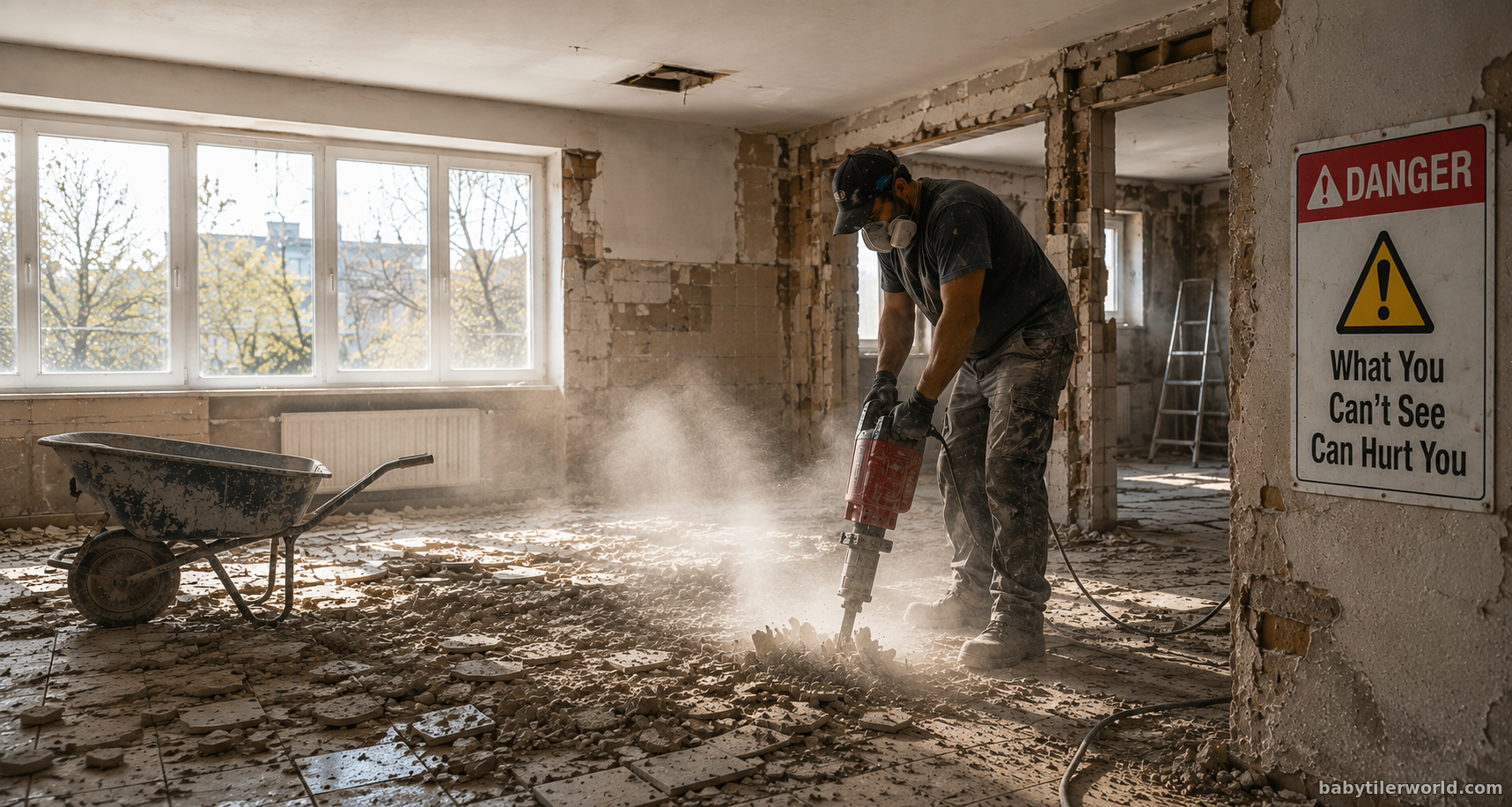
What You Can't See Can Hurt You
Picture this.
After months, maybe even years, of saving money and planning, renovation day has finally arrived.
The old tiles are coming off. New flooring is stacked neatly against the wall. Bags of cement line the hallway, and workers move confidently from room to room with trowels, grinders, and buckets in hand. The rhythmic sound of hammers breaking concrete echoes through the house, while clouds of grey dust swirl through beams of sunlight streaming in from an open window.
To most homeowners, this scene represents progress.
Every broken wall, every chipped tile, and every layer of fresh cement feels like one step closer to the home they've always imagined.
But hidden within that cloud of dust is a reality few people stop to consider.
Some of the particles floating through your home are so small that they cannot be seen by the human eye. They drift silently through the air, settle on furniture, circulate through ventilation systems, cling to clothing, and remain suspended long after the workers have packed up for the day.
You may wipe the dust off your dining table, vacuum the floor, and open the windows, believing the danger has passed.
In many cases, it hasn't.

More Than Just a Mess
When people think about home renovation, they usually worry about budgets, timelines, design choices, or unexpected delays.
Health rarely makes the list.
Construction dust is often dismissed as nothing more than an inconvenience, something to be cleaned up once the work is complete. Yet modern scientific research tells a very different story.
The World Health Organization (WHO) recognizes airborne particulate matter as one of the most significant environmental health risks worldwide. Fine particles suspended in the air can penetrate deep into the respiratory system and are associated with a wide range of health problems, including respiratory disease, cardiovascular disease, and reduced lung function. Although the WHO's guidance addresses airborne particulate matter broadly, many renovation activities generate these same fine particles indoors, where exposure can be even more concentrated.
This is particularly important because home renovations frequently involve activities that produce large amounts of airborne dust, including:
* Breaking concrete floors
* Cutting ceramic or porcelain tiles
* Mixing cement and mortar
* Grinding concrete surfaces
* Sanding walls
* Removing old plaster
* Chiseling brick and masonry
* Demolishing existing structures
Each of these tasks releases thousands, sometimes millions, of microscopic particles into the surrounding air.
Some settle within minutes.
Others remain airborne for hours.
The smallest can travel throughout the entire house.
The Dust You Don't See
Our eyes are surprisingly poor at judging air quality.
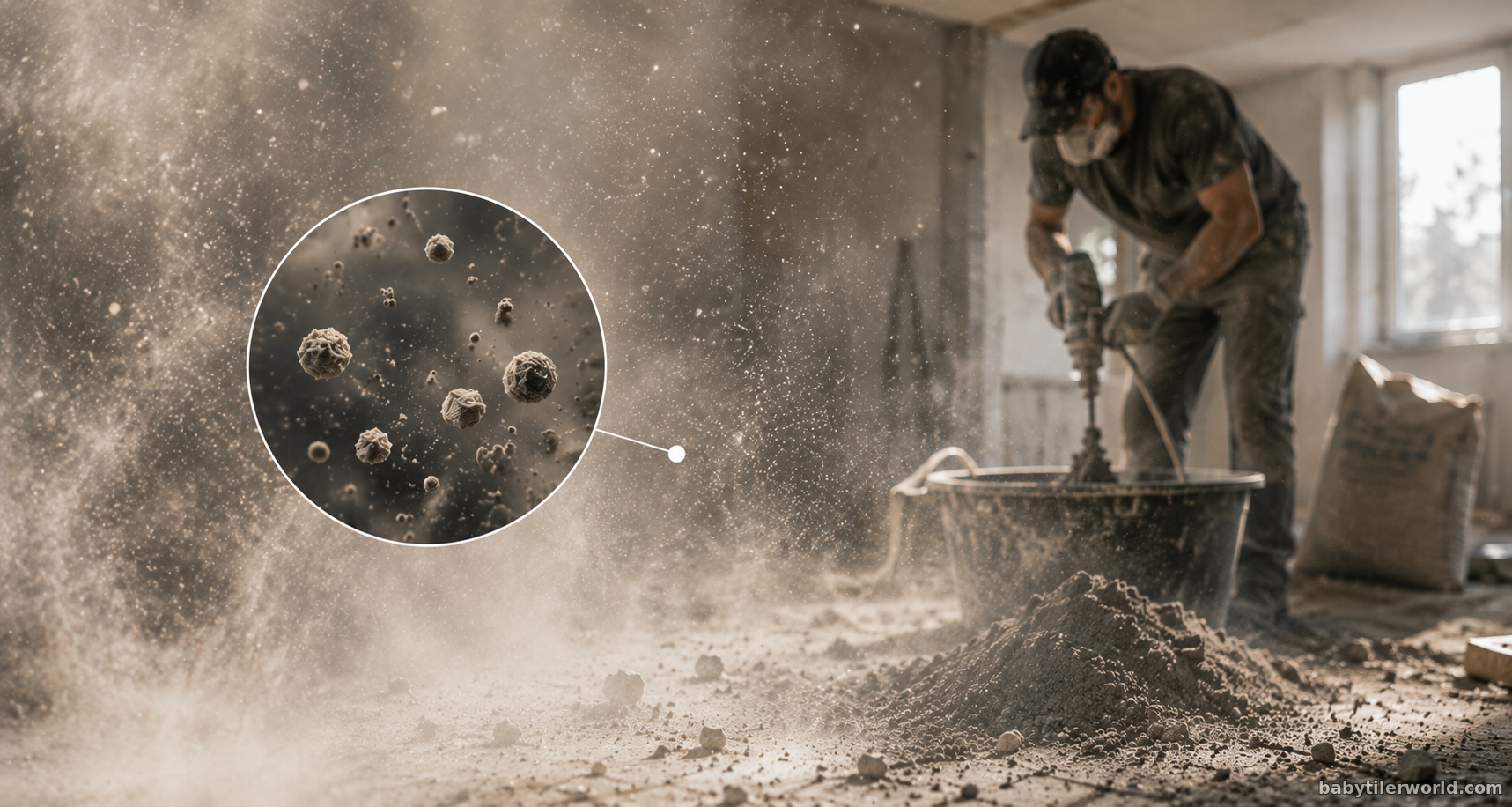
If sunlight shines through your window, you might notice larger dust particles dancing through the light. Those are only the particles large enough to scatter visible light.
The truly concerning particles are often invisible.
The World Health Organization explains that airborne particles smaller than 10 micrometres (PM₁₀) are capable of entering the respiratory tract, while even finer particles, known as PM₂.₅, can travel much deeper into the lungs. These particles are measured in micrometres, a unit so small that a single human hair is roughly 50 to 70 micrometres wide.
To put that into perspective:
* A human hair is approximately 60 micrometres thick.
* PM₁₀ particles are about one-sixth the width of a human hair.
* PM₂.₅ particles are around twenty-four times smaller than the width of a human hair.
Particles this small cannot usually be seen floating in the air, but they can still be inhaled with every breath.
Now imagine hundreds of thousands of these microscopic particles being released every time a worker cuts concrete with a power saw or mixes dry cement into a bucket.
The room may appear relatively clear only minutes later, yet countless fine particles may still be suspended in the air around you.
Cement Is Only Part of the Story
Many homeowners assume that "cement dust" simply comes from bags of cement.
In reality, renovation dust is much more complex.
Whenever workers drill, grind, sand, or demolish cement-based materials, they generate a mixture of airborne particles that may include:
* Cement dust
* Concrete dust
* Mortar dust
* Brick dust
* Plaster dust
* Masonry dust
* Fine mineral particles
* In some situations, respirable crystalline silica, particularly when cutting or grinding concrete, mortar, brick, or other silica-containing materials.
This distinction matters.
One of the most significant health concerns during renovation is not merely the presence of ordinary dust, but the potential release of respirable crystalline silica.
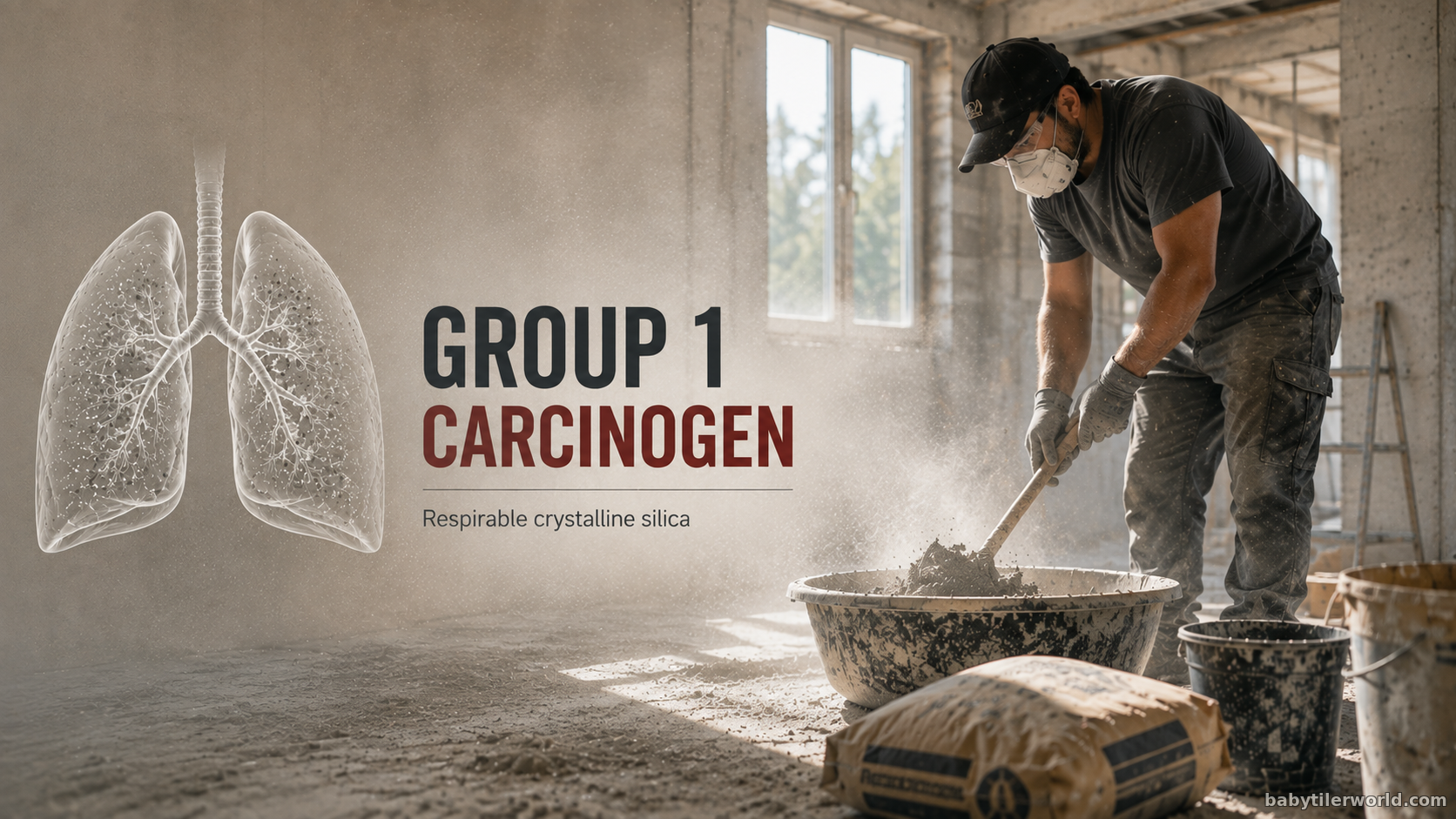
The International Agency for Research on Cancer (IARC), a specialized cancer research agency of the World Health Organization, classifies inhaled crystalline silica generated during occupational activities as a Group 1 carcinogen, meaning there is sufficient scientific evidence that it can cause cancer in humans after prolonged occupational exposure.
It is important to understand that not every renovation releases hazardous levels of silica. The amount depends on the materials involved, the type of work being carried out, the tools being used, the duration of the work, and the dust-control measures in place.
However, whenever cement-based materials are cut, drilled, ground, or demolished, reducing dust exposure should be considered an essential part of the renovation process.
A Home Becomes a Temporary Construction Site
One of the biggest misconceptions about renovation is that the work area is confined to a single room.
Dust doesn't respect doorways.
Fine airborne particles can move throughout a home by:
* Air currents created by open windows.
* Ceiling fans.
* Air conditioning or ventilation systems.
* Workers walking from room to room.
* Shoes carrying fine dust.
* Clothing covered in construction residue.
* Tools and equipment.
Within hours, dust generated in one room can settle in bedrooms, kitchens, wardrobes, electronic equipment, and even children's toys.
Researchers studying indoor air quality have repeatedly shown that fine airborne particles can migrate far beyond their original source, particularly in enclosed environments where ventilation is limited.
This is why homeowners often discover a fine layer of dust throughout the house, even in rooms where no work was carried out.
Why Your Body Can't Always Protect You
The human body has remarkable defenses against the outside world.
Tiny hairs inside your nose help trap larger particles.
Sticky mucus captures many airborne contaminants before they reach your lungs.
The throat and airways work together with microscopic hair-like structures called cilia to move trapped particles back toward the mouth, where they can be swallowed or expelled.
These natural defenses are highly effective against larger dust particles.
But they were never designed to stop every microscopic particle created by modern construction equipment.
According to the World Health Organization, the smallest airborne particles are capable of bypassing many of these natural defenses, travelling deep into the lungs where gas exchange occurs. Some ultrafine particles may even pass from the lungs into the bloodstream, where they can contribute to broader health effects beyond the respiratory system.
While a single afternoon of light exposure is unlikely to cause lasting harm for most healthy people, repeated or prolonged exposure, particularly during extensive renovations without proper dust control, can significantly increase health risks.

The Cost of Ignoring the Invisible
For professional construction workers, dust exposure is an occupational hazard that has been studied for decades.
Many countries now require dust-control measures, protective equipment, and exposure limits because of the well-documented health risks associated with airborne construction dust.
Ironically, homeowners often receive far less guidance, despite spending days or even weeks living inside the same environment where renovation work is taking place.
Unlike construction workers, who typically wear protective equipment and eventually leave the worksite at the end of the day, homeowners may continue sleeping, eating, cooking, and raising children in spaces where fine dust remains present.
The danger isn't usually one dramatic moment.
It's the slow accumulation of exposure.
Breathing a little dust today.
A little more tomorrow.
Then again the next day.
By the time the renovation is complete, your beautiful new home may look spotless, but your lungs have already been exposed to days or weeks of unnecessary airborne particles.
Renovating Safely Begins with Understanding
None of this means you should avoid renovating your home.
Modern construction materials have transformed the way we build safer, stronger, and more beautiful living spaces. Cement remains one of the most important building materials ever developed, forming the foundation of homes, hospitals, schools, bridges, and cities around the world.
The goal is not to create fear.
The goal is to create awareness.
The encouraging news is that most health risks associated with renovation dust can be significantly reduced through proper planning, effective dust-control methods, good ventilation, appropriate personal protective equipment, and careful cleaning practices.
In other words, the danger is real, but so are the solutions.
What You'll Learn from our other articles
Over the following chapters, we'll answer questions that every homeowner should know before starting a renovation:
* What exactly is cement, and why does it produce dust?
* What is the difference between cement dust, concrete dust, and crystalline silica?
* How do these microscopic particles affect your lungs, skin, and eyes?
* Why are children, older adults, and people with asthma at greater risk?
* What practical steps can you take to protect yourself and your family?
* How can you ensure your dream renovation doesn't come at the expense of your health?
By the end of this guide, you'll understand not only what happens during a renovation but why it happens, how it affects the human body, and what you can do to create a healthier, safer home throughout the renovation process.
|