How Renovation Fills Your Home with Airborne Dust
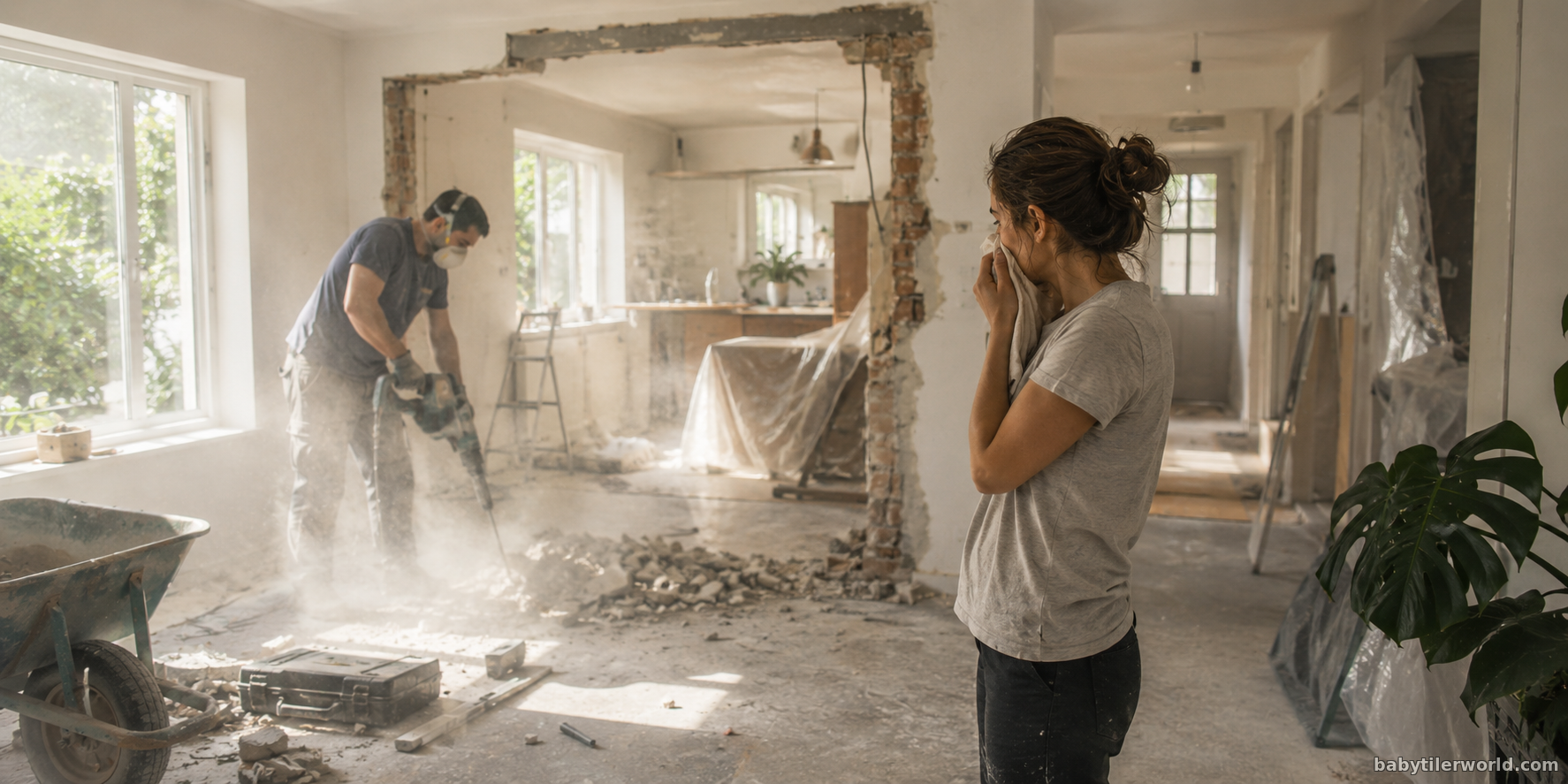
Imagine standing in the middle of your living room as a renovation project begins.
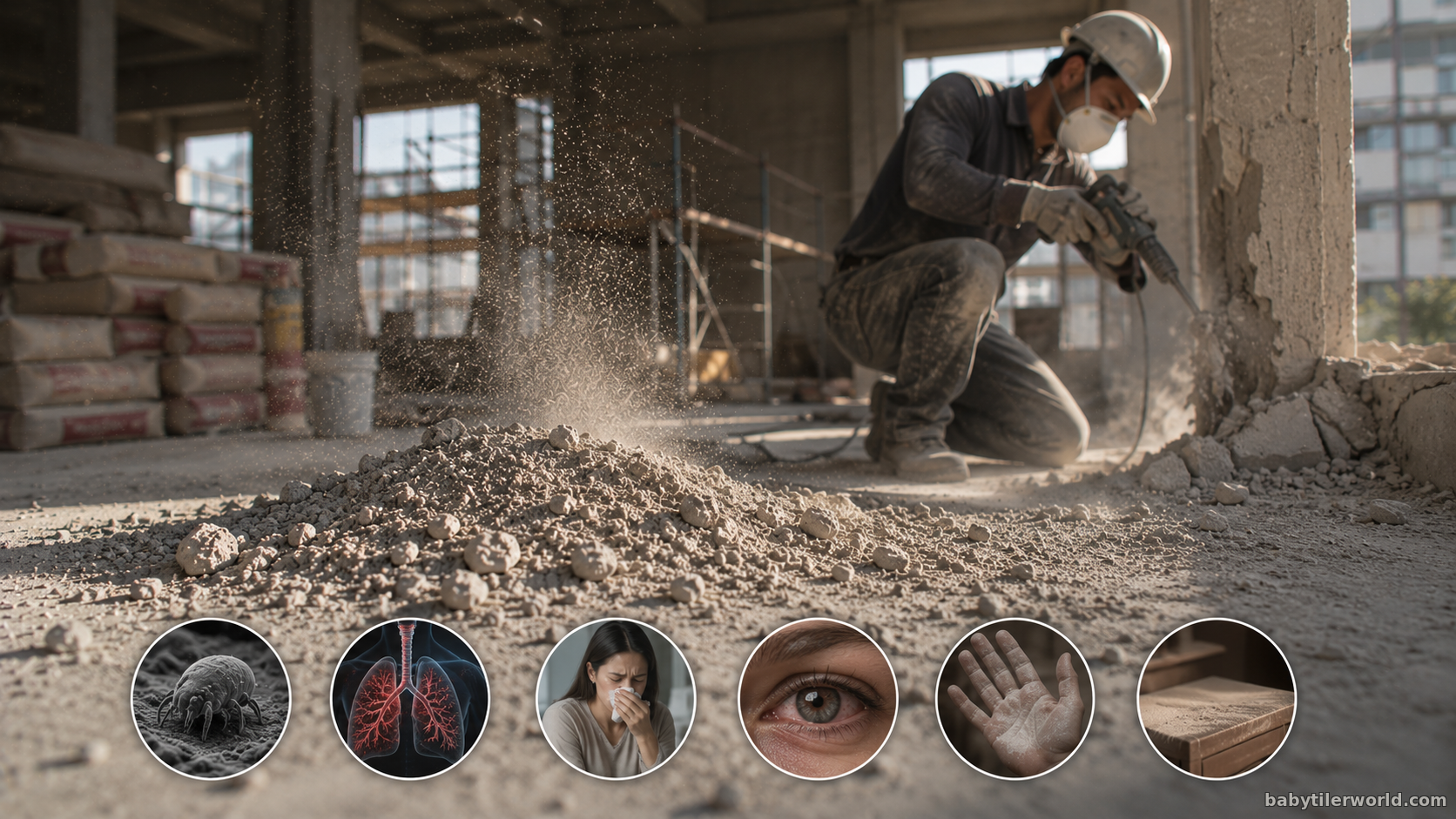
The furniture has been pushed aside and covered with plastic sheets. Workers carefully mark the floor before switching on a concrete grinder. Within seconds, the quiet room is transformed. The machine roars to life, sending a pale grey cloud billowing into the air. Sunlight streaming through the windows suddenly reveals thousands of tiny particles floating like a dense fog.
The larger pieces quickly settle onto the floor.
The smaller particles drift slowly toward the hallway.
The finest particles disappear completely.
At first glance, it seems as though the dust has vanished.
In reality, it has only become invisible.
What most homeowners don't realize is that the greatest danger during a renovation isn't necessarily the dust they can see. It's the microscopic particles that remain suspended in the air long after the tools have been switched off. These particles are small enough to travel through your home, settle on everyday surfaces, and be inhaled without you ever noticing.
This invisible transformation, from solid stone to airborne particles, is one of the most overlooked aspects of home renovation.
Every Renovation Begins by Breaking Something Apart
Renovation is, by its very nature, a process of transformation.
Before a beautiful new kitchen can be installed, the old one must be removed.
Before new tiles can be laid, the existing floor often needs to be broken up.
Before fresh walls can be painted, damaged plaster may need to be sanded away.
Every one of these activities involves breaking solid materials into smaller pieces.
Sometimes those pieces are large enough to sweep into a pile.
Sometimes they become dust.
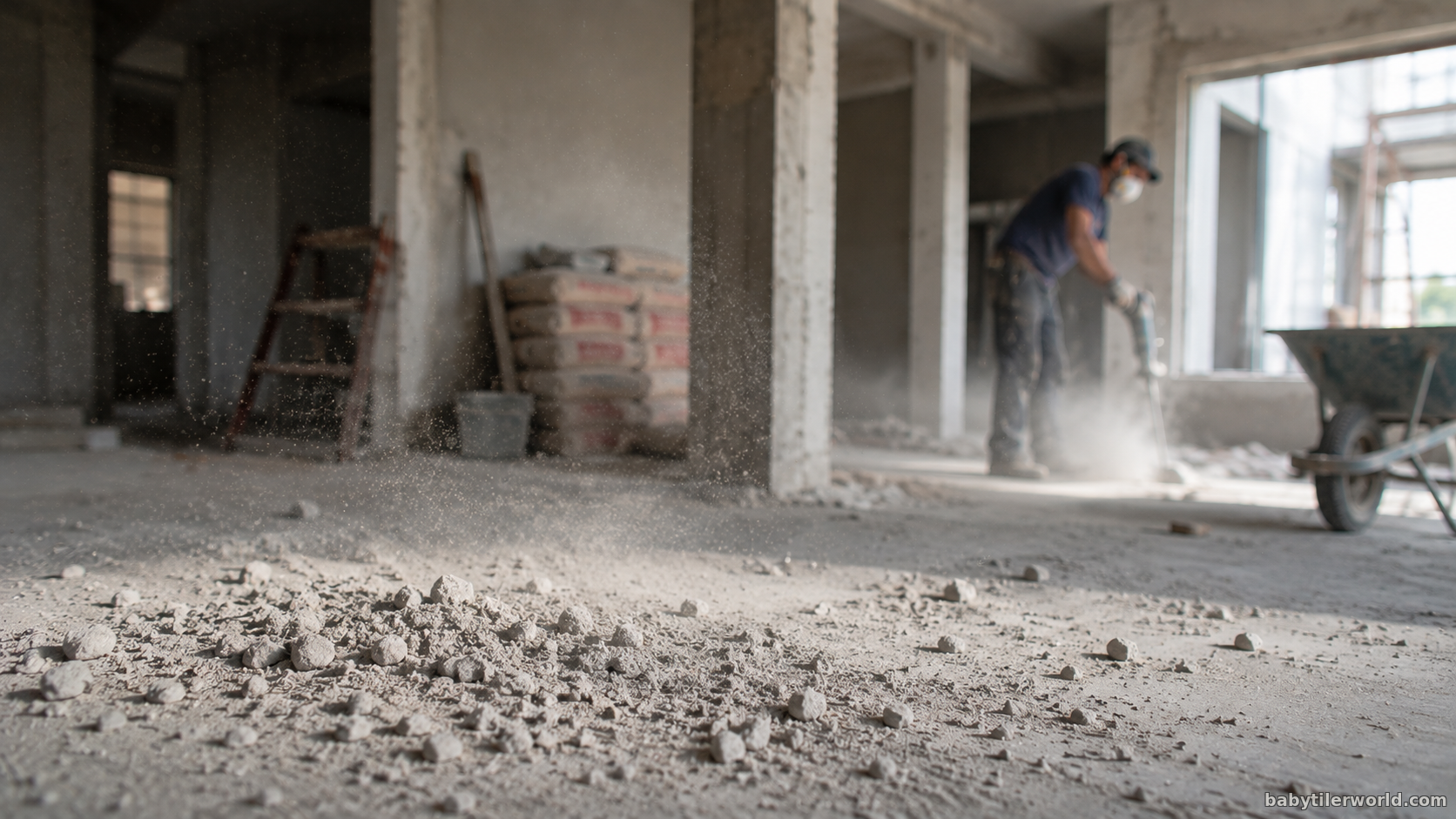
The moment a worker cuts concrete with a diamond blade, drills into a masonry wall, or grinds hardened mortar, millions of tiny fragments are released into the surrounding air. Some are large enough to fall immediately under gravity. Others are so small that they behave almost like smoke, floating through the room and following air currents wherever they go.
This is why demolition often appears much dustier than ordinary construction work. Instead of simply assembling materials, demolition tears apart hardened surfaces that have taken years to form, creating particles of many different sizes in the process.
Dust Is More Than Dirt
Many people use the word dust as though it describes one single substance.
Scientifically, it does not.
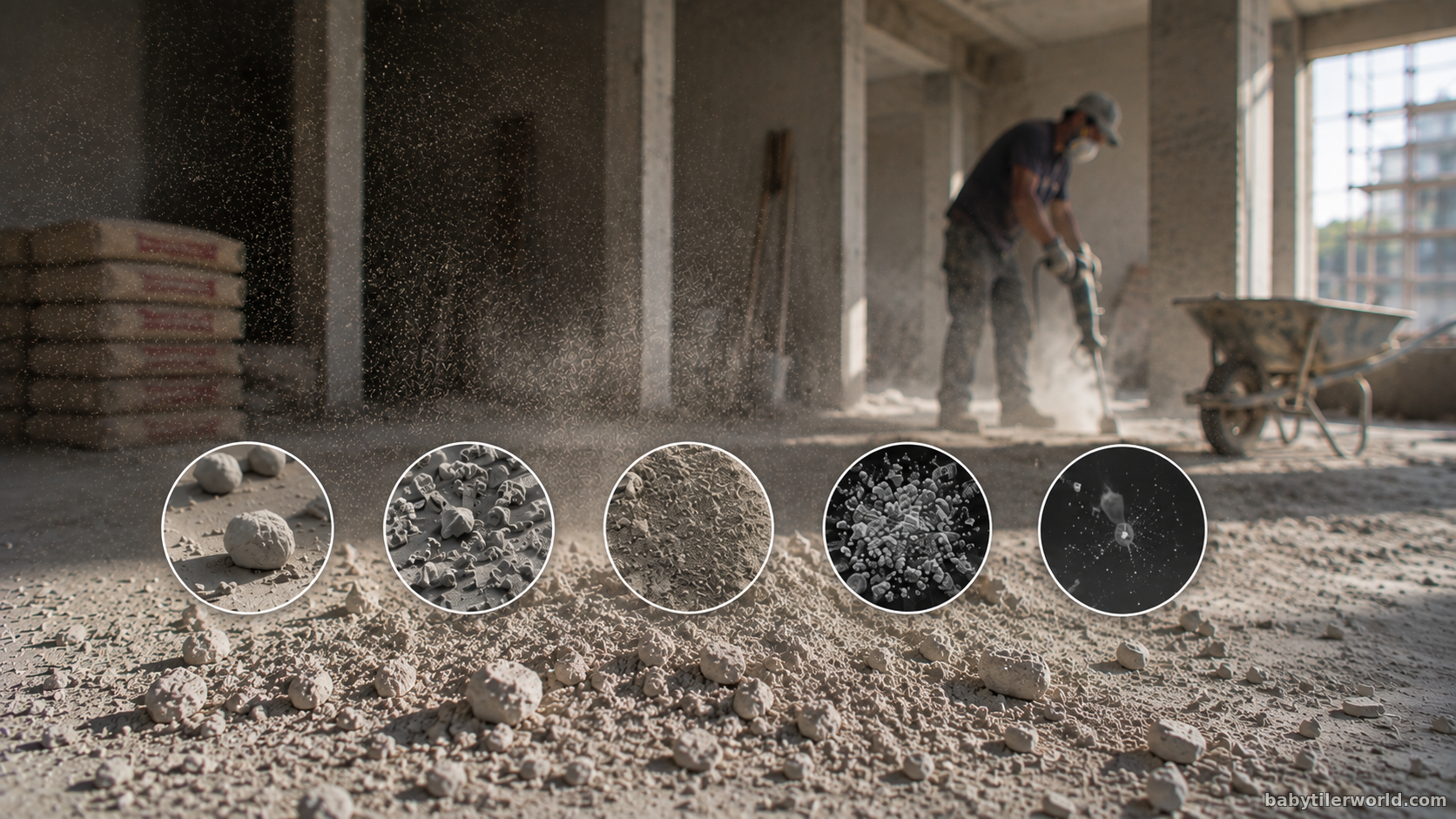
Construction dust is a complex mixture of particles that may include:
* Cement dust
* Concrete dust
* Mortar dust
* Brick dust
* Plaster dust
* Sand particles
* Paint residues
* Wood fibres
* Gypsum
* Mineral fragments
* In some cases, respirable crystalline silica
The exact composition depends on the materials being worked on.
For example, removing ceramic floor tiles creates a different type of dust than sanding drywall or demolishing a concrete slab.
Although these particles look similar once they settle on the floor, they can behave very differently in the air and inside the human body.
How Solid Materials Become Airborne
At first, it seems almost impossible.
How can something as hard and heavy as concrete become a cloud floating through the air?
The answer lies in physics.
Concrete may appear solid, but it is made of billions of tiny mineral particles tightly bonded together by hardened cement paste.
Whenever force is applied, those bonds begin to break.
Imagine dropping a ceramic plate onto a tiled floor.
It doesn't simply split into two pieces.
It shatters into hundreds of fragments.
Some are large.
Some are tiny.
The same principle applies during renovation.
A hammer striking concrete creates cracks.
A grinder removes microscopic layers from the surface.
A saw slices through hardened material at extremely high speeds.
Every impact creates particles ranging from visible chips to microscopic dust.
The smaller the particle becomes, the easier it is for air to lift and carry it away.
The Invisible Spectrum of Dust
Not all dust behaves the same way.
Large particles are relatively heavy.
Gravity pulls them to the floor within seconds or minutes.
These are the particles you sweep up after renovation.
Fine particles are different.
According to the World Health Organization (WHO), airborne particulate matter is classified by its size because size determines where particles travel within the respiratory system.
Particles known as PM₁₀, which are smaller than 10 micrometres, can enter the nose and upper airways.
Even finer particles, known as PM₂.₅, are capable of travelling much deeper into the lungs.
To appreciate just how small these particles are, consider that a single human hair is roughly 50 to 70 micrometres wide.
A PM₂.₅ particle is about twenty-five times smaller.
Particles this tiny cannot usually be seen by the naked eye.
Yet they may remain suspended in the air for hours, especially inside enclosed spaces with poor ventilation.
This explains why a room may appear clean even though microscopic particles are still present.
Why Dust Doesn't Stay in One Room
Many homeowners believe that simply closing the renovation room door will keep dust contained.
Unfortunately, air doesn't recognize walls in the way we imagine.
Every time someone opens a door, fresh air moves between rooms.
Windows create pressure differences.
Ceiling fans circulate air.
Heating and cooling systems move air throughout the house.
Even people walking from one room to another create small air currents.
As a result, fine dust slowly migrates beyond the work area.
It settles on bookshelves.
Inside wardrobes.
On children's toys.
Across kitchen countertops.
Even inside electronic equipment.
Research into indoor air quality has shown that fine airborne particles can travel surprisingly long distances indoors before finally settling, particularly when ventilation systems or natural air currents continue moving the air.
This is why homeowners often discover a layer of grey dust throughout the house, even though renovation only took place in one room.
When Dust Becomes More Than a Cleaning Problem
Most people judge dust by what they can wipe away with a cloth.
Health professionals judge dust differently.
The greatest concern isn't how much dust settles on furniture.
It's how much remains suspended in the air long enough to be inhaled.
Every breath draws air deep into your respiratory system.
If that air contains microscopic construction particles, some of them may bypass your body's natural defenses.
The World Health Organization explains that the smallest airborne particles are capable of penetrating deep into the lungs, where they can contribute to respiratory and cardiovascular health problems after repeated or prolonged exposure.
Certain renovation activities add another concern.
When workers cut, grind, drill, or demolish materials containing crystalline silica, they may release respirable crystalline silica into the air.
The International Agency for Research on Cancer (IARC), a specialized agency of the World Health Organization, classifies inhaled crystalline silica generated during occupational activities as a Group 1 carcinogen, meaning there is sufficient scientific evidence that it can cause cancer in humans after prolonged occupational exposure.
This does not mean every renovation creates dangerous levels of silica.
The amount released depends on the material, the tools used, the duration of the work, and the effectiveness of dust-control measures.
Nevertheless, it highlights why controlling dust at its source is so important.
Why Dust Can Remain Long After the Workers Leave
One of the biggest misconceptions about renovation is that once the noise stops, the danger is over.
In reality, the air inside your home may still contain microscopic particles.
Fine dust settles much more slowly than larger debris.
Some particles remain suspended for several hours, especially in enclosed spaces with little air movement.
Others settle onto furniture only to become airborne again when someone walks across the room, shakes a curtain, or vacuums with an ordinary household cleaner.
This cycle of settling and resuspension means that exposure doesn't end when the tools are turned off.
It continues until the dust has been properly removed using effective cleaning methods.
The Importance of Dust Control
Fortunately, dust doesn't have to become an unavoidable part of renovation.
Modern construction practices increasingly focus on controlling dust before it spreads.
The International Labour Organization (ILO) emphasizes that controlling airborne hazards at their source is one of the most effective ways to protect health.
In practical terms, this means:
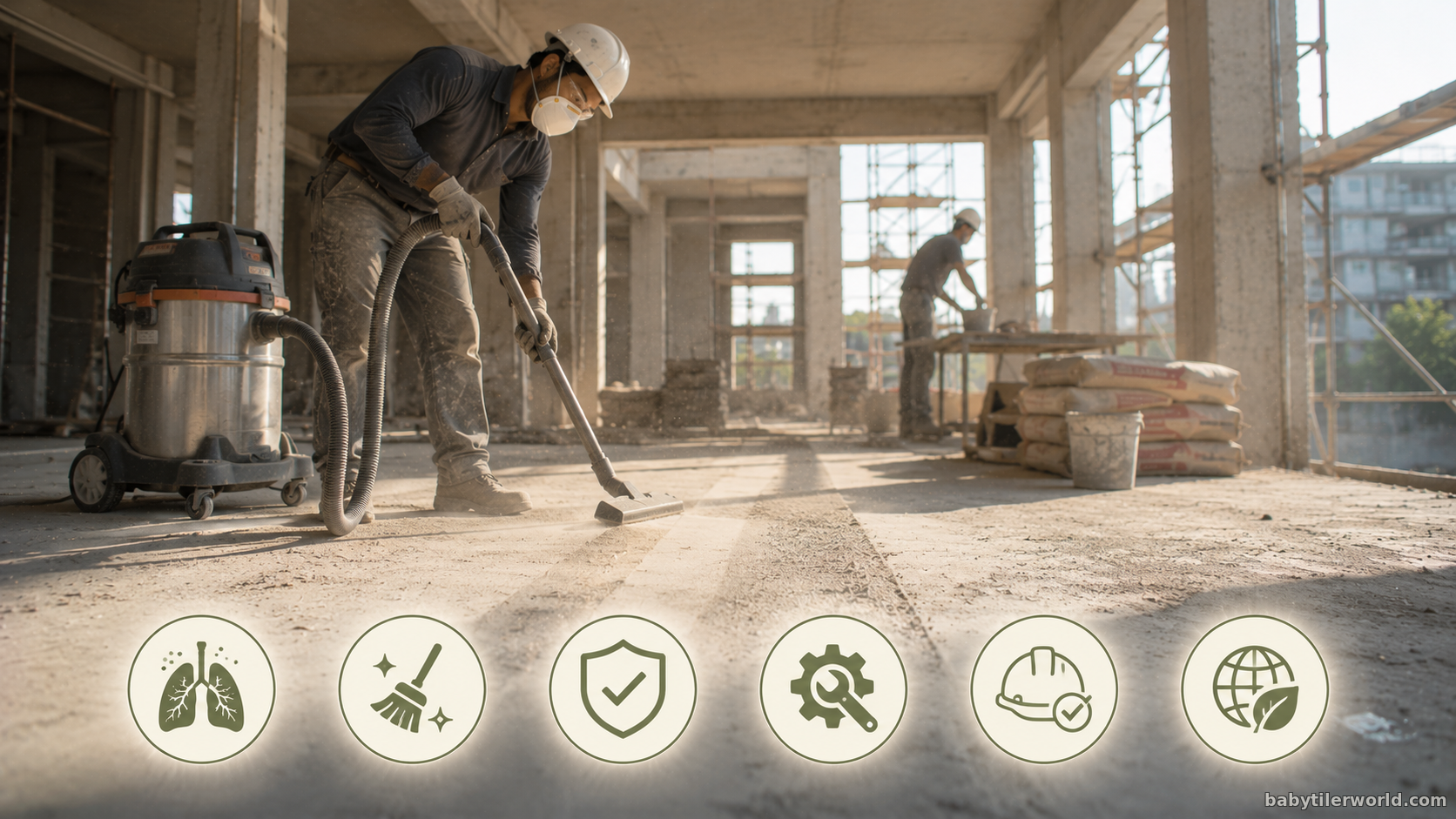
* Using water to suppress dust while cutting or grinding.
* Connecting power tools to dust extraction systems.
* Isolating renovation areas with plastic barriers.
* Improving ventilation where appropriate.
* Cleaning with HEPA-filter vacuums rather than dry sweeping.
* Wearing properly fitted respiratory protection during high-dust activities.
These measures not only protect workers but also reduce the amount of dust entering the rest of the home.
Looking Ahead
Now that we've seen how solid building materials are transformed into microscopic airborne particles, the next question becomes even more important:
What happens after you breathe them in?
How do these invisible particles interact with your nose, throat, lungs, skin, and eyes?
Why are some people affected more severely than others?
And what determines whether exposure leads to temporary irritation or long-term health problems?
In the next article, we'll follow the journey of cement dust inside the human body, exploring the science behind inhalation, the body's natural defenses, and why particle size plays such a critical role in determining health outcomes.
|